
Akedah: The Binding of Love: The Love That Held Jesus to the Cross
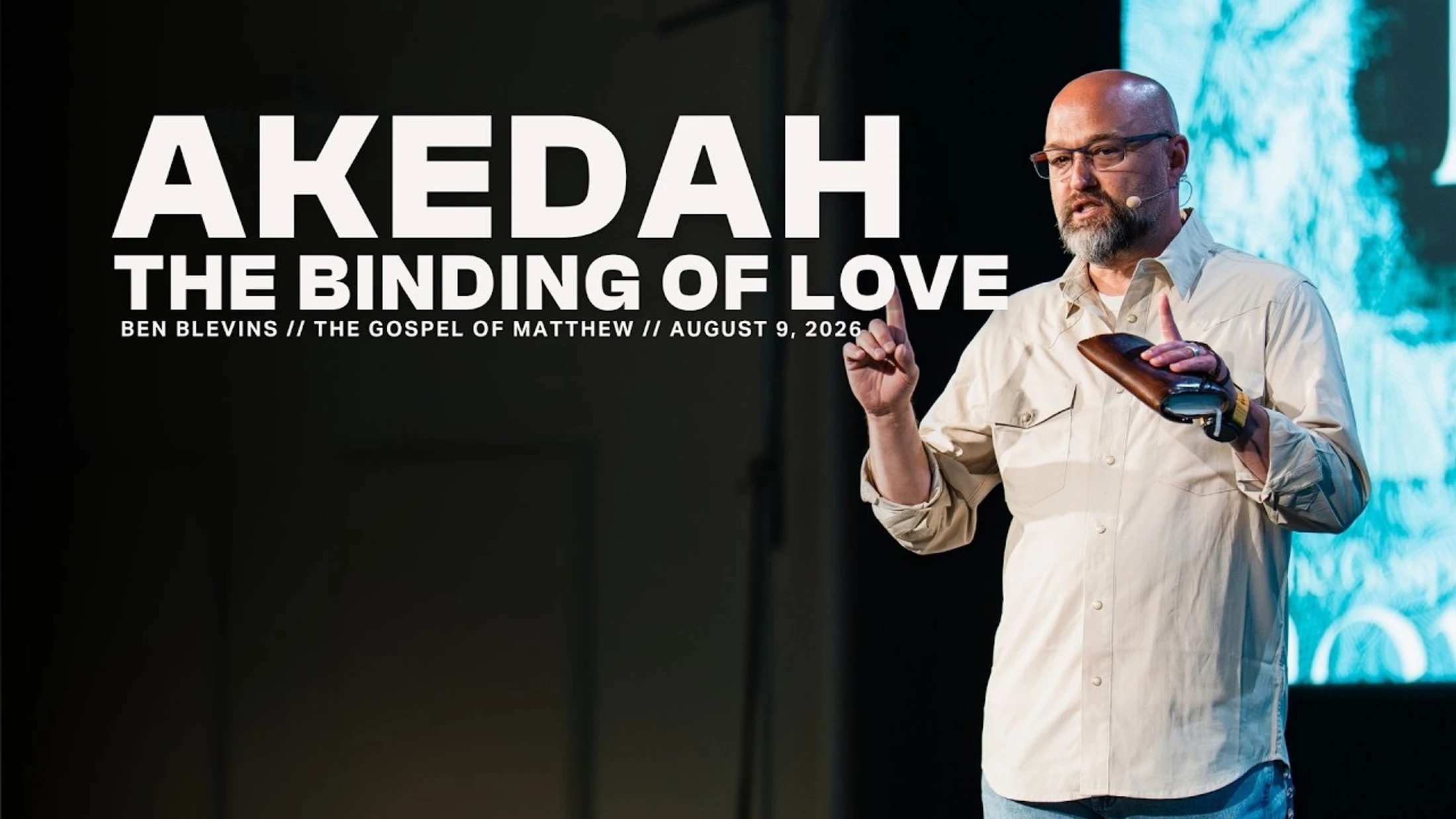
Someone once said that if you want to hear God speak, read the Bible. If you want to hear him speak audibly, read it out loud. This Sunday, Ben Blevins let his own kids read the crucifixion account from Matthew 27 over the congregation, and it landed differently coming from young voices. Most of us already know this story. Jesus had to die. His blood covers our sin. God needed a substitute to redeem us.
But Ben did something worth sitting with. He stepped back into Genesis 22, the Akedah, the binding of Isaac, and asked us to look there first so we could come back to the cross and see what we may have missed. Not a different story. The same story, with more of the picture filled in.
A Son Worth Waiting a Hundred Years For
God told Abraham in Genesis 17 that he would become the father of many nations. The problem was timing. Abraham was one hundred years old. Sarah was ninety and had been barren her entire life. God said it was not too late. They had a son and named him Isaac.
If you have ever waited on something here on the Palouse that you could not rush along, a harvest or a hard season, you understand a sliver of what a hundred years of waiting feels like. Isaac was proof God keeps his word even when the math does not add up.
The First Time God Ever Tests, the First Time God Ever Loves
Then God comes to Abraham to test him. The text tells us up front that this is a test, and that matters, because what God asks next is so far outside his character that we need to know he does not actually want it to happen. Take Isaac, your only son, the son you love, God says, to the region of Moriah, and offer him there as a burnt offering.
The Hebrew word for test is nasa. It shares a root with a word that means miracle, and it can also mean a banner, something lifted up for everyone to see. A test is not designed to expose what is weak in you. It is designed to raise you to a place you did not think possible. Here is the detail easy to miss: this is the first time the word test appears anywhere in the text, and also the first time the word love appears, in the very same command. This was never only a test of obedience. It was a test of love.
Abraham had a choice. He could obey, or he could run in the night. He did neither. When the angel called his name, he answered, "Hineni." Here I am. Fully present. Ask what you need, and I will give it.
Three Days, and a Question on the Mountain
The next morning, Abraham saddled the donkey, gathered his servants and his son, cut the wood, and set out. This was not a sudden act. They walked for three days, Abraham carrying the death of his son already decided in his heart.
On the third day, Abraham told his servants to wait while he and Isaac went to worship. He placed the wood on Isaac's back, took the knife and fire himself, and they walked up together. Of every conversation this father and son could have had, only one is recorded. Isaac asked, "Father, we have the wood. I am carrying it. You have the knife and the fire. Where is the lamb?" In Hebrew, the question lands closer to, "Something is supposed to be here, and it is not. Am I the lamb?"
Abraham did not dodge the question or distance himself from his son. "The Lord himself will provide, my son." He did not get to choose the lamb. God did. But he chose how he would walk with his son until the moment he no longer had a choice.
The Ram Caught in the Thorns
They reached the top. Abraham built the altar, arranged the wood, and bound Isaac onto it. He reached for the knife. The angel of the Lord cried out from heaven, "Abraham, Abraham, stop." He answered again, "Here I am." He looked up, and caught in a woven bramble of thorny vines was a ram. He sacrificed it in Isaac's place. The rabbis say that with every piece of that sacrifice, Abraham said, "Let this be in place of my son Isaac."
God spoke again. Because Abraham did not withhold his only son, his descendants would be as numerous as the stars, and through his line the whole world would one day be blessed. Abraham named that place "The Lord Will Provide." Generations later, David bought that ground for a threshing floor, and his son Solomon built the temple on top of it. That mountain is Mount Moriah, the same mountain range where Jesus would later be crucified.
Held There by Love, Not by Nails
Bring that picture forward to Matthew 27. Soldiers weave together a bramble of thorny vines and press it onto Jesus's head. They strip him, mock him, dress him back in his own clothes, and bind him to the crossbeam to carry up the mountain. Isaiah had written that the Messiah would become a nasa, a banner lifted up for the nations to rally to. Simon of Cyrene helps carry the load. The crowd mocks him: "He saved others, but he cannot save himself. If he is the Son of God, let him come down."
If this were only about our sin, this is the point where he gets off that cross. He was not held there by the nails, and he was not held there only by your sin. He was held there by his love for you. Jesus said it himself: there is no greater love than to lay down your life for another. We needed a sacrifice, but that is not the reason God did it. He did this because he loves you. Do you know how much you are loved?
The Curtain Torn Like a Father's Grief
At nine in the morning they crucified him. At noon, darkness fell over the land for three hours. While the crowd mocked him, Jesus said, "Father, forgive them, for they know not what they do." The relationship was still intact. He was still the Son, and God was still the Father. They simply did not yet know that love. At three in the afternoon, at the hour of the evening sacrifice, he gave up his life.
An earthquake followed. Rocks split. Tombs broke open. In the temple, the curtain separating the Holy of Holies from everyone else, four inches thick and sixty feet tall, tore top to bottom, the way a father tears his own garments in grief. It also opened the Holy of Holies to the world. I have been behind this curtain long enough, God was saying. I am coming out to dwell in you, so you will know my deep love.
Remember You Are Loved
Look at how closely these two stories mirror each other. Isaac and Jesus were both born through the miraculous, one to a woman ninety years past childbearing, one to a virgin. Both were only sons, led up the same mountain, carrying the wood meant for their own sacrifice. Both show one life given in place of another, a ram for Isaac, Jesus for us. Both happened out of a father's great love. God foreshadowed on Moriah what he would do on Golgotha a thousand years later. It was never going to be Isaac. At the last moment, God provided a substitute, and this time he did not send someone else to be it. He came himself.
That is what makes communion so weighty. On the night he was betrayed, Jesus sat with the disciples he loved, talking about the blood of the lamb, took the bread, and broke it. "This is my body, given for you." There is no greater love than to give your life for a friend. When you do this, remember how much I love you. After the meal, he took the cup of redemption and said, "This is my blood, poured out for you and for many, so that you will know how much you are loved." When you do this, remember you are loved.
Taking It Into Tuesday
This was not a sermon about proving a theological point. It was about a father's love, shown twice, on the same mountain, a thousand years apart. Before you move into your week, sit honestly with a few of these.
- Do you believe you are loved by God, or mostly that you are tolerated because a sacrifice was required?
- Abraham chose how he walked through his test without pulling away from God or Isaac. Where are you pulling away right now instead of staying present?
- Isaac asked his father a hard, honest question on the mountain. What question have you been afraid to bring to God directly?
- The ram was provided at the exact moment it was needed, not a moment before. Where are you assuming God has run out of provision?
Join Us This Sunday
This was never only a story about sin and sacrifice. It is a story about how far a father will go for the child he loves, and it is your story too. We gather every Sunday at 9:00 AM and 11:00 AM at the Eastside Marketplace in Moscow. We have a place for your kids through Lifer Kids, and each week we take communion together as a family, remembering the love that was given for us.
Come as you are. We would love to meet you.