
The Trial That Put Everyone on Trial: What Will You Do With Jesus?
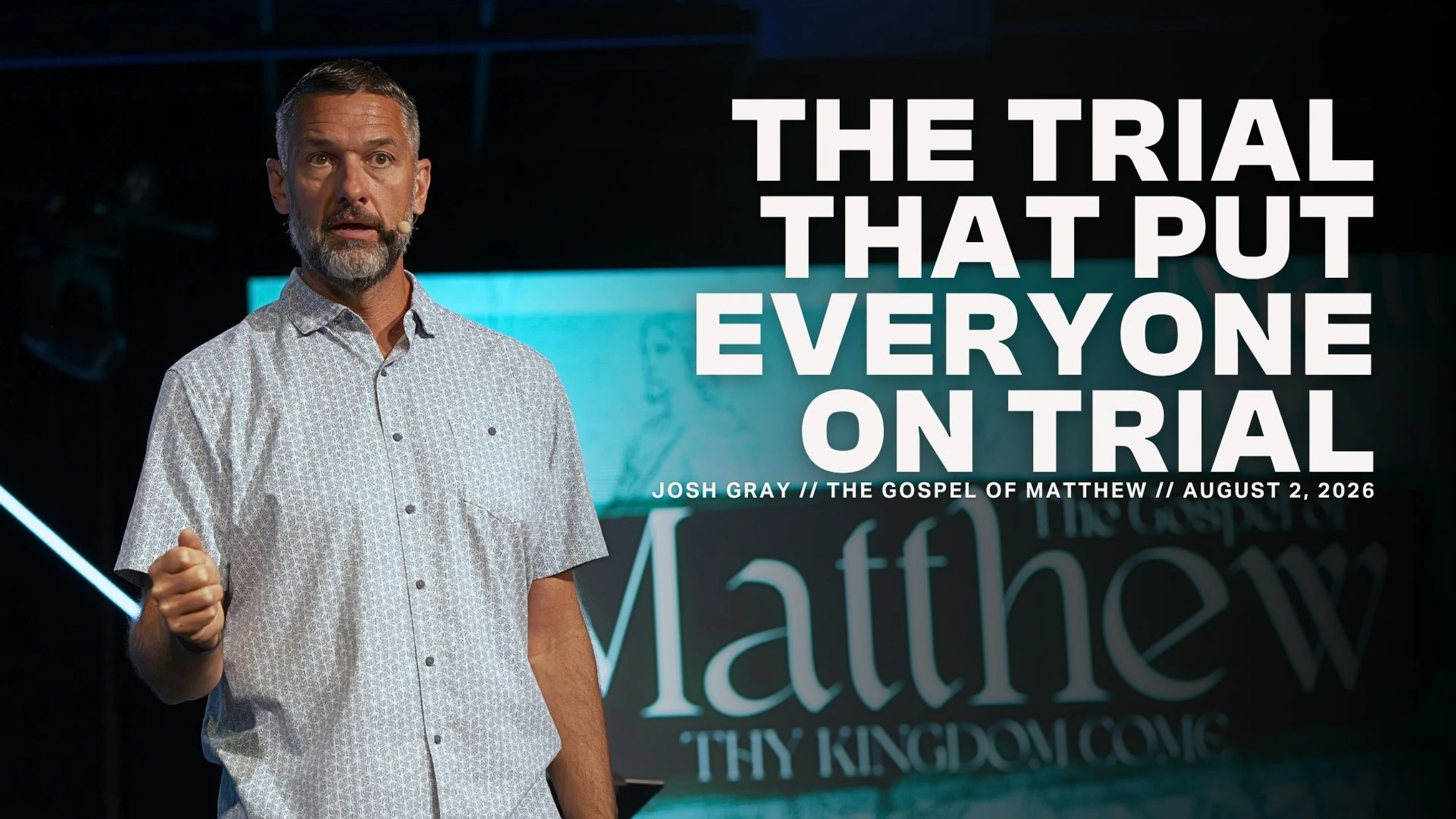
Pastor Josh opened this weekend by naming the moment plainly. The sham trial with the Sanhedrin was over. Peter had denied Jesus three times, and Judas had already done what he was going to do. Now Jesus stood before Pontius Pilate, the one man in the room who held the actual power of life and death.
Josh titled the message "The Trial That Put Everyone on Trial." As he said it, the greatest trial in history was not Jesus before Pilate. It was humanity before Jesus. It is us before Jesus.
Pilate asked a question that has echoed through every century since: what shall I do with Jesus? It is God's question to every person who has ever lived, including you. You have the freedom to reject Jesus for a hundred reasons, but you cannot remain neutral. Neutral is a no.
A Trial Won Through Silence
Matthew 27 lays it out simply. The chief priests and elders bound Jesus and handed him to Pilate, who asked, "Are you the king of the Jews?" Jesus answered, "You have said so." When the chief priests piled on accusation after accusation, Jesus said nothing, not to a single charge. Matthew says Pilate was amazed.
Josh pointed out how strange this is. In Roman courts, defendants fought for their lives, because everyone knew what a Roman crucifixion looked like. Jesus does not beg, does not defend himself, does not run, though he clearly had the power to walk away.
Why the silence? Because he knew the text. Isaiah 53 had already said it: he was oppressed and afflicted, yet he did not open his mouth. He was led like a lamb to the slaughter. Josh made a distinction that matters here. Jesus was not powerless in that moment. He was purposeful, surrendering to the Father's will, the same will Josh said he has been praying through the Lord's Prayer at his bedside for six weeks straight. That is what Jesus modeled in his silence. Not defeat. Obedience.
Letting God Be Your Defender
Josh brought this home in a way that was hard to sit with. Think about how often you fight to defend yourself, or how many times you have been misunderstood or falsely accused, maybe even by someone close to you. Josh admitted he has been on both sides of that.
What changed for him was learning to let God be his defender instead of fighting every battle himself. He shared a story of someone who had spoken badly about him and about Real Life, then later called to apologize. Josh's response was simple: "You are forgiven, my brother, but I did not do that. We let God be our defender." The Holy Spirit does the convicting, not us. Jesus trusted the Father with his reputation on the way to the cross. The question Josh left in the room was whether we trust Jesus with ours.
Two Jesuses, One Wrong Choice
Then comes a detail Matthew wants you to notice. The prisoner the crowd could release alongside Jesus was named Jesus Barabbas, and Barabbas literally means "son of the father." Two men carrying that name stood before the crowd: one violent, one peaceful, one guilty, one innocent.
The crowd chose the wrong one.
Josh shared something his mentor once told him: watch what the masses are doing, then do the opposite. The crowd wanted a Messiah who would overthrow Rome by force, not one who healed an ear his own follower had just cut off. They could not accept a King who said to turn the other cheek. Jesus had not come to overthrow Rome. He had come to overthrow sin, for that generation and every generation after, including this one on the Palouse.
Josh was honest that most of us do not reject Jesus outright. We substitute him instead, for our own version of truth, our political party, our happiness, our dreams and identity. Josh named his own version of this: turning Jesus into an adviser he consults when convenient rather than the Lord he submits to. There is a real difference between having an adviser and having a King.
Washing Hands That Cannot Be Cleaned
Pilate knew Jesus was innocent. His own conscience told him so, and so did his wife, after a troubling dream. Yet Pilate caved, not because he feared Jesus, but because he feared the crowd and what an uproar might cost his career. So he washed his hands in front of everyone and said, "I am innocent of this man's blood."
Josh pointed out the irony Matthew is quietly building. Handwashing was a Jewish symbolic act, and Pilate, a Roman governor, borrows it here as though ceremony could clean away guilt. It cannot. Guilt is removed through sacrifice, and the very blood Pilate rejected that day was the only thing that could have cleansed him.
We still wash our hands today, with busyness, excuses, blame, politics, and church attendance, telling ourselves that walking through the doors on Sunday is the same as following Jesus. It is not. Being in this building does not make you a Christian, and telling yourself someone else will carry the responsibility for your own voice does not make that true either.
The Guilty Go Free
Barabbas deserved the cross. Jesus did not. Yet Barabbas walked free, and Jesus was condemned. Josh said it plainly: Barabbas is us. The guilty go free, and the innocent is condemned in their place.
Everyone in this story has blood on their hands except Jesus. The priests think they have won, Pilate thinks he made a careful decision, the crowd thinks it is in control. But Matthew wants you to see something deeper: Jesus is completely sovereign through the entire scene. No one takes his life from him. He gives it. This was never a backup plan. It was always the plan. That is the shocking grace of the gospel: the only innocent blood in the story is the only blood that saves anyone, including the people shouting for it to be spilled.
Taking It Into Tuesday
Josh's closing challenge was not abstract. It was the same question Pilate asked, aimed at every person in the room: what will you do with this Jesus? Will you say a prayer once and then live however you want, or will you wake up tomorrow and actually ask, "Lord, what shall we do today?"
Sit with a few of these questions this week:
- Where in your life are you still fighting to defend your own reputation instead of trusting God to be your defender?
- What have you quietly substituted for Jesus as Lord? Your own version of truth, your political loyalties, your happiness, your dreams for your future?
- If you are honest, are you closer to the crowd that wanted a Messiah of power, or a follower of the Messiah who chose the cross?
- What are you washing your hands with this week? Busyness, blame, excuses, or simply showing up on Sunday, hoping it counts as clean hands?
- Tomorrow morning, will you treat Jesus like an adviser you consult when it is convenient, or like the King you actually submit to?
What Will You Do With This Jesus?
That question does not stay in the pages of Matthew. It followed us into communion this weekend, and it follows you into this week. The innocent King silently accepted condemnation so the guilty could go free. You and I are the guilty ones who get to walk out free, the moment we confess with our mouth that Jesus is Lord and believe in our heart that he was raised.
We would love for you to bring that question with you this Sunday. Join us at 9:00 AM or 11:00 AM at the Eastside Marketplace in Moscow. Kids are cared for and taught well through Lifer Kids, and we take communion together every week, because we never want to forget who Jesus is and what he did for us. Come as you are, and bring your honest answer to Pilate's question with you.